Sunday, January 20, 2008

Kata Tjuta

After the day at Uluru we got up bright and early to catch the sunrise from a sand dune between Uluru and Kata Tjuta. Kata Tjuta is the lesser known part of Uluru-Kata Tjuta National Park. It's a collection of sandsone and conglomerate domes that together cover just over 8 square miles of bush west of Uluru. I was particularly looking forward to visiting Kata Tjuta for several reasons. It's bigger than Uluru, its less well known than Uluru, its more sacred to the Anangu than Uluru, and more of it is off limits to non-Aboriginal people for cultural reasons than Uluru. Neither site has been commercialized to any great degree but to me Kata Tjuta feels less touristy than Uluru. I can't describe why exactly, but Kata Tjuta felt more primordial to me than anywhere else in the Outback.

Uluru is big in an obvious way. After all, the incongruity of a massive chunk of sandstone rising hundreds of meters straight out of an otherwise flat-as-a-pool table landscape is difficult to miss. Kata Tjuta, on the other hand, is as understated as Uluru is obvious. It's far more massive than Uluru, but deceptively so. It's not a single monolith, but a series of gigantic stones several of which are inidividually taller than Uluru, all packed together with spaces in between. The enormity of Kata Tjuta is easy to miss because the relatively featureless scrub surrounding it can make it seem a lot closer than it is at any given point, its far enough away from Uluru that an accurate visual comparison is difficult to make, and Kata Tjuta's stones are arranged in a roughly circular pattern. This means that from anywhere except overhead Kata Tjuta always looks more 2-dimensional than it is in reality.
The law component of Tjukurpa includes certain aspects that are particularly relevant for men or women. In our language these are called simply women's law and men's law. I was only able to scratch the surface of the Tjukurpa associated with Uluru and Kata Tjuta, but I was left with the impression that the significance of Kata Tjuta cannot be overstated, particularly in men's law. I was told that Kata Tjuta means "many heads". In Tjukurpa the domes of Kata Tjuta are understood to be the tops of the heads of the Mala men, ancestral giants that figure prominently in the Tjukurpa stories surrounding Uluru as well. There are several other snippets of stories about Kata Tjuta that seem to have leaked out the Anangu culture, but for non-Aboriginal people there remain many more secrets than explanations of the traditional significance of Kata Tjuta.

There are only two routes that non-Anangu people are allowed to take into Kata Tjuta's interior. I took the Valley of the Winds walk, which is the longest of the two, and as its name suggests follows a natural wind tunnel between the rocks. It opens into a natural ampitheather formed by the surrounding domes. The expansive landscape inside Kata Tjuta is undetectable from the outside. As with Uluru, the geologists seem to be unable to agree on a scientific explanation of Kata Tjuta's origins, but they do agree that much more of the domes are currently below ground than above it.

Maybe the geologists ought to talk to the Anangu. They seem to know exactly where Kata Tjuta came from. Too bad they're not telling.


Wednesday, January 9, 2008

Uluru

The next morning began my 3 day tour of the center of Australia's best known attractions. Between stops we took in some other sights, including some wildlife, a working cattle ranch, and some interesting roadhouses. Uluru was first on the itinerary.

For those who have heard that Uluru is in or near Alice Springs, it isn't. We spent the first morning from about 6 am till right about noon covering the roughly 250 miles of bush between them. A word to the wise concerning outback travel: you can get more places in a ute than you can in a big air conditioned tour bus, but they are nowhere near as comfortable. If you ever find yourself on a ute tour of the outback sit in the front seat if you can. Your back and butt will thank you. Also, pack light, wear comfortable shoes, and don't bring anything that you don't want impregnated with stubborn red dust. And one more thing: be ready for scenery that's out of this world.

Before we got to Uluru we had to gas up at a roadhouse and a quick inspection of the back paddock revealed a pair of camels. Few people outside Australia understand the significance of the camel in Australia's history, but this animal was critical to European exploration and settlement of the outback. The camels came to Australia as pack animals with Afghan immigrants, who were themselves brought to Australia to work on developing infrastructure (primarily railroads) in the arid center of the country. The transcontinental railroad here is called the Ghan in honor of the Afghans' resilience in the desert environment, and their contribution to early exploration of the interior. Their camels quickly became the favorite mode of trasportation for savvy outback travelers due to their durability, ability to haul heavy loads, and modest food and water requirements when compared with horses. Given these attributes, their less desirable behaviors such as spitting and biting were understandably forgiven. I gave the local cameleer a couple of dollars to do a lap around the paddock on one of his beasts and was immediately impressed by how tall they are. I have ridden horses a fair bit, and you are a LOT higher off the ground on a camel than on any horse. They are so tall that you can't climb onto them like a horse. The better trained ones kneel so you can get on or off, otherwise you have to use a ladder. Camel saddles are much simpler and harder than horse saddles, but they were a welcome respite from the horrors of the back seat in our ute. To borrow an Australian turn of phrase, riding in that ute was hard yakka. It got to feel like a kick between the big toes.

Once we got to Uluru we had a walk around the the base and visited a few of the culuturally significant sites around the base. The most striking thing to me about Uluru is its size (the path around the base is nearly 4 miles long), but almost equally as surprising is the way the texture of the rock changes with location or perspective. From one place it may look perfectly smooth, from another it will look wavy, and from another it could appear jagged and craggy. In some places the rock almost appears to be rotting away as the surface is pocked with hundreds of little caves and tunnels. The walk around the base took almost 2 1/2 hours and it seemed that at every vantage point the rock had a different texture or appearance, even though the entire structure is a single giant piece of stone.

The Anangu people are the traditional residents of this part of Australia. The Anangu consist of two separate groups, the Yankunytjatjara and the Pitjantatjara. Their Tjukurpa or Wapar (in the Pitjantatjara or Yankunytjatjara languages, respectively), which means roughly religion, heritage, and law all rolled into one concept, provides traditional explanations of how many of Uluru's features came into existence. In some places this knowledge is recorded in rock paintings, but the Anangu say the natural texture and color of the rock tells the history of their land, which in turn forms their religion. In their traditional belief system you don't need a natural history textbook to tell you how modern landforms came into existence because the land itself is the text. The Anangu are not unique in this regard. Most Aboriginal groups regard ancient history to be self evident in today's landforms to those who know how to interpret them. The law component of Tjukurpa or Wapar is conveyed orally.

One of the most important aspects of Tjukurpa or Wapar is that long ago, ancient beings called Tjukuritja shaped what was previously a featureless earth through their activities. The Tjukuritja were the ancestors of modern humans, plants, and animals. When humans inhabited the earth the Tjukuritja didn't leave, but either took spirit form or became integrated into the land. Thus in Tjukurpa, a mountain or stream may not only be the track left by Tjukuritja, it may be the Tjukuritja itself. Because the land not only tells the stories of their ancestors but also contains the ancestors themselves, the land is sacred to the Anangu and stewardship of the land is their sacred duty.

There are many stories that together make up the history of Uluru as the Anangu understand it. Most of them revolve around a conflict between two giant snakes. Even in my very short time there I heard different versions of the story, but the basic thrust of the story as I understand it is that one snake, Kuniya, came to Uluru from the west. At the same time a venomous snake called Liru approached from the opposite direction. A conflict ocurred in which Kuniya ultimately killed Liru. In some versions Kuniya and Liru take the form of opposing tribes which identify with snakes, and Kuniya is often associated with a mother or motherhood. The versions that include the tribes of people explain that the holes in Uluru's face are the marks left by the combatants spears, and waterholes around the base are drops of blood from wounded combatants. I was told that one rock formation in particular is supposed to be Kuniya in snake form looking back at Uluru as she left the battlefield. I came away from Uluru thinking that like most purely oral traditions, Tjukurpa or Wapar seem to have central themes that are constant, but that the details can be adjusted to suit the teller or the audience. To me the story of Kuniya and Liru seems to be about the conflict of good over evil and the cost of waging that fight.

Photos:

1. Our ute and trailer next to the quintessential outback road: long, straight, dusty, and empty.

2. Camel riding
3. The group with Uluru in the background. The couple on the right were from Scotland, the two in the back were students from the US studying in Australia, the woman on my left was a British traveler just in from southeast Asia, and the one in black to her left was Dutch.
4. This is probably the best photo I have to demonstrate the size of Uluru. It seemed to go straight up, and the summit isn't visible in the photo.
5. The stone that is supposed to represent Kuniya. The snake is looking back to the right over itself.

Sunday, January 6, 2008

Alice Springs

For those of you who have been reading this and giving feedback through Angel and the rest of my family, thanks. It's nice to know people are reading this. I apologize for not keeping up to date over the past several weeks but there hasn't been much to write about. Hopefully that's about to change so stay tuned.

In the meantime it's a good opportunity to catch up on my trip to the center of the country. After I got done in Sydney I was off to Alice Springs, which I used as a jumping-off point for Uluru, Kata Tjuta, and Kings Canyon. Uluru and Kata Tjuta are also known as Ayers Rock and the Olgas, respectively, but as mainstream Australia has become more aware of Aboriginal culture these landmarks are becoming better known by their traditional Aboriginal names. All are well known but Uluru in particular is one of the most photographed landmarks in world.

Most people get to these places through Alice Springs. I had a day to spend in town so I gave myself the walking tour. I had read that it was home to nearly 30,000 people and growing rapidly so I expected a busy town. I could not have been more wrong. If nearly 30,000 people live in "Alice" as it is known, then most of them are either invisible or were on vacation that week. School was in and the holidays weren't for another month so vacation seemed unlikely. More on the invisible residents of Alice later.

I ambled through a couple Aboriginal art galleries on my way to the one thing in Alice that I was keen as mustard to see: the Royal Flying Doctor museum. The RFD is a medical service that provides emergency care to rural Australians who live so far away from urban centers that conventional emergency services aren't practical for them. Alice Springs is just about the geographical center of the country but isn't close to anything else. In a quirky way that is oh so Australian, its extreme isolation makes it the perfect place for the hub of the RFD network.

Lots of museums I've been to are filled exclusively with old stuff, but not the RFD museum. The museum touches on the history of the RFD but emphasizes the RFD's important role in contemporary outback life. The RFD is so integral to the security of outback residents that some households maintain private airstrips just so the RFD will have a place to land in case of emergency. In addition to flying ambulances, the RFD provides medical chests with drugs and equipment to outback residents, and will dispense advice on how to use them by radio. Everything in the chests is numbered, which helps clarify potentially confusing instructions. They even have an observation room where I watched dispatchers take calls and plot the day's flights. These dispatchers often have to share microphones with doctors giving critical advice to caregivers in order to keep victims alive until the RFD arrives on scene.

Like many things in Australia the RFD has its share of amusing anecdotes. My favorite concerns an old stockman who's wife became ill. The stockman radioed the RFD for advice, who prescribed a single pill from one of the vials in the cattle station's RFD chest. The stockman had been less than fastidious in his maintenance of the chest's contents, and found that he was out of the required medicine. Not to be deterred, he administered enough medicines from the other numbered vials to add up to the number on the vial that had been prescribed. Apparently outback medicine is equal to the sum of its parts, because the stockman soon radioed the RFD that his wife "came right straight away".

On the way back to my hostel I walked by the Todd River. The term "river" is a bit of a misnomer for the Todd. It's really a dry gulley that gets a little damp once in a great while. When I was there the "river" hadn't flowed for six months or so. Every year the town has a cardboard boat race down the Todd. Contestants have to construct a boat to enter, but rather than paddle them down the river they sprint down the dry riverbed carrying, dragging, or wearing their craft as they go. The organizers are quite proud that this event is the only boat race in the world that is cancelled in the unlikely event that the race course is actually wet.

Aboriginal culture is prominent in Alice Springs. There are several Aboriginal art galleries in town that appear to generate tidy sums for the indigenous communities, and many Aboriginal people work in the tourism industry as guides, for the government as park rangers, or running their own businesses. There is growing pressure to conduct the tourism industry that drives Alice Springs' economy in a manner that is not only sensitive to Aboriginal culture, but that emphasizes the Aboriginal perspective on natural and human history, and empowers and benefits the Aboriginal communities around Alice Springs.

This brings me back to the invisible residents of the town. A progressive approach to tourism has not benefitted all Aborigines equally. After walking along the Todd for a few minutes I had noticed quite a few Aboriginal people coming and going across the channel, and it became clear that there was a sizeable group of them living on the outskirts of town. I talked with a townie about it and she confirmed that there are quasi-settlements on the fringes of town where some Aborigines live in deplorable conditions, and that substance abuse is rampant in these communities. According to her the people I saw in the riverbed were members of these communities. Tourism drives the Alice economy, but poor inebriated indigenous people don't make for a pleasing tourism experience. These folks are the invisible part of Alice Springs' population.


Photos:

1. The nerve center of the Alice Springs RFD hub. These dispatchers were taking emergency calls as I watched and had one patient with a life threatening injury in transit when I was there.

2. The mighty Todd River.

Saturday, December 8, 2007

The Pinnacles

A while back I got the itch to go exploring. I had heard that there were some interesting rock formations called the Pinnacles within a day’s drive up the coast, and that the area between Perth and there was fairly remote. I decided to drive up the coast a few hours to see the Pinnacles and to see whether it's really as remote up there as I had heard. There were a few places I wanted to check out along the way too so I made a day of it. Perth is wedged between two of Australia's most noted wine regions, the Margaret River Valley and the Swan River region. The Swan River region is the closer of the two to where I live, maybe about 40 minutes northeast of the city. There are dozens of vineyards in the area. I’m not a wine nut but I think some of the notable ones are Sandalford, Fish Tail, and Riverbank Estates. Even if you’re not a wine afficianado the scenery is nice. I sped through the vineyards away from civilization and pretty soon got north of Yanchep and out into the real countryside. There was nothing for miles on end except scrub and the road I was on.

After having been south along the coast and around the city already I thought I knew what to expect once I got north of Perth, but no. The coastline south of Perth is dry but still has forested areas and green pastures, especially in the sheep ranching areas. Going north is a whole different experience. After I got out of the Swan it got really dry, really quick. No farms, no houses, and very little vegetation. This part of the west coast is so undeveloped that roadhouses show up on map atlases that cover the entire country. Ones that are open 24 hours are rare, and are printed in bold. It's equivalent to seeing Bob's Mini Mart on a Rand McNally Atlas of the US.

It continued that way for 2 or 3 hours until I got to the little town of Lancelin. Lancelin is like so many other tiny Australian towns. There are no significant businesses to speak of. It is a lonely outpost on the west coast of Australia that has a cluster of a few dozen nondescript houses, a run down fish and chips shack next to the local roadhouse (which also serves as the post office, hotel, pub, social club, and general center of local commerce and social life), a few mangy dogs, and some even mangier looking bogans. At first glance Lancelin doesn’t seem to have any real reason for existing except that it is literally the end of the road. Highway 60, which is a proper 6 lane highway in Perth and at least a sealed road until Lancelin, abruptly becomes little more than a dirt path in Lancelin. There are three ways of continuing north from this point: parking your car and walking (which will more than likely kill you); driving into the great unknown on an unmaintained, rutted, poor excuse for a road (which also has a fair chance of resulting in your demise, and does so for dozens of foolishly adventurous motorists in Australia every year); and turning around and backtracking about 20 miles to the next road inland.

I was about to take the third option for leaving Lancelin when I rounded the corner and saw the reason that Lancelin exists. It was one of those rare postcard moments, the kind when you take a picture because you feel you have to, but knowing full well that the camera won’t do justice to what you are seeing. Laid out in a perfect half circle was one of the most perfect beaches I have ever seen. Perhaps the only more picturesque beach I have ever been to was on the extreme eastern end of Vieques, but that doesn’t count because it was so nice only because at that time it had been kept under lock and key by the US military for the last 60 year or so. This place was a public beach, accessible to anyone who took the time to find it. The water was so clear I could see a reef sitting under breaking waves about a mile offshore. The sand was pure white, the sea bright green, there was no trash, and I could see for probably a mile in either direction and could only spot maybe 10 or so people and a handful of windsurfers running between the beach and the reef. There are no signs to tell you it’s there, which is probably due equally to two facts: as I was to find out later in the day there are so many of these beaches around north of Lancelin that it’s not locally noteworthy, and there wouldn’t be very many people around to read the sign if someone bothered to erect it. I had my lunch there before remembering that I still had to get farther north in time to see the Pinnacles before dark.

Driving north out of Lancelin the road got more lonely than it had been before. It was about three hours straight of bush on my right, and low hills with sand dunes beyond them on my left. Every now and again the Indian Ocean showed as a thin ribbon of blue through the dunes. Even more occasionally I’d see a pasture or a dirt track leading to some unknown desination over the horizon. It lasted like that all the way to Cervantes.

Just outside Cervantes I finally reached the Pinnacles. The Pinnacles are a collection of stone pillars that cover about 30 square miles in the middle of Nambung National Park just south of Cervantes. According to the favorite geological theory at the moment, the Pinnacles are the remnants of a limestone deposit that leached away through a complex combination of chemical and biological erosion. According to this theory after the limestone was deposited in the form of coral reefs, the ocean receded and a forest grew over the limestone. As tree roots gradually fractured the limestone, acidic groundwater leached into the limestone along the root channels and dissolved the vast majority of it. The Pinnacles are what’s left of the limestone, and they only exist where a calcrete layer between the limestone and the acidic forest humus was too thick for the roots to penetrate. Sounds good to me.

The Pinnacles are an eerie place. It’s always changing because being near the coast the wind nearly always blows, and the sandy soil shifts in the wind constantly, exposing new pinnacles and burying others as the dunes move. Most are roughly cigar-shaped, and to me they are faintly reminiscent of tombstones.

The landscape is almost completely without vegetation, but certainly not without life. I found emu tracks in the sand, as well many numerous other tracks that I couldn’t identify. I also saw a sand monitor on the road and a pair of emus just outside the park on my drive home. Emus are ugly birds and I found out that they are curious about people as long as people don’t show an interest in them. The birds were in the bushes along the side of the road and watched as my car rolled by and came to a stop. However; as soon as I got out to take a picture they bolted out of sight through the bush.
After driving and hiking through the Pinnacles it was time to head back to Perth. I was white-knuckling it all the way for fear of hitting kangaroos, but luckily the roos stayed off the road and I got back to Perth in the middle of the the night without incident.
1. Lancelin Beach
2. Me at the Pinnacles
3 and 4. More Pinnacles.
5. Emu track in the sand.

Thursday, December 6, 2007

Speaking Australian - Part 2

Done a funny-this is the same as “stuffing” something up, but I like this term better. The other day when a virus got loose on our servers at the office I asked the administrative assistant what had happened. She replied “The system’s done a funny mate, and now we’re stuffed.”

Smoko-used to be a smoke break, but now that smoking is falling out of favor a smoko is any break from work. I think the sneaky one is gradually replacing the smoko.

Dunny-can be any toilet, but is mostly refers to a Porta Pottie or an outhouse.

Kenny-a fictitious character in an Australian mockumentary by the same name. Kenny cleans and rents dunnies for a living and he happens to be the most popular man in Australia at the moment, even though he’s not real. Just as you cannot be any keener than mustard, you cannot be any more Strayin than Kenny. If you don’t believe me Google Kenny and Australia and see what happens.

Willy willy-this is not a stuttering relative of mine, it’s a mini-tornado. Or as they call them in some parts of the US, dust devils.

Bottle O-Liquor store. There’s a local bottle-O chain that employs a guy in a yellow foam bottle suit to hide in the bushes outside their shops and jump out to serenade their customers on the way in (scaring them half to death in the process). They film it and turn the footage into TV commercials. He always jumps them on the way in, instead of on the way out when they could drop their bottles of booze on the pavement. He’s so considerate.

Bugger-We covered this a little bit before but I’ve realized since then that bugger is a highly versatile word. It can be an adjective meaning small or very little, as in “He’s got bugger all chance with that bird”. It can be a directive, as in “Bugger off, you bogan!” Just a simple “Bugger!” is an exclamation of disgust or frustration.

She’ll be right-To an Australian this means something between “No worries” and “It’s ok”. It’s also often said as a way of giving up and going to the pub when things are so feral they simply can’t be put right again. What’s that you say-a white pointer just bit your leg off? No worries mate, she’ll be right. You’re burning to death? She’ll be right, have a sneaky one and you’ll be heaps better. A death adder is sucking on your carotid artery? She’s a keen bugger, but she’ll be right. You get the idea. To be Australian is to be unflappably relaxed no matter what occurs, because after all, she’ll be right.

Ordinary or average-In Australia, ordinary means average, average means bad, and fine means good. Confused yet? If an Australian surfer tells you the waves are average, surf conditions are so bad it’s not worth getting the board out of the closet. If the weather’s ordinary, it’s pretty nice, and if it’s fine, it’s perfect. However, Western Australians are spoiled in the weather department, so it has to be really excellent to be fine. Anything short of excellent is at the very best ordinary, which is not really so bad, but nowhere near as good as fine. Got it?

Higgeldy Piggeldy-This is a close relative of feral, but it’s heaps more fun to say.

Budgie Smugglers-These are the little bikini bottom swimming suits that European and (unfortunately) some Aussie guys wear at the beach. A friend of mine distinguishes them from underwear purely on a geographic basis. If you can’t see the water from where you’re standing they’re underwear, if you can they’re budgie smugglers.

Sunday, December 2, 2007

Sydney

History, architecture, and giant bats that fly around in the daytime-Sydney's got it all. I spent 4 days in Sydney a couple of weeks ago. It's not nearly enough time to see all the city has to offer but I did my best with the time I had.

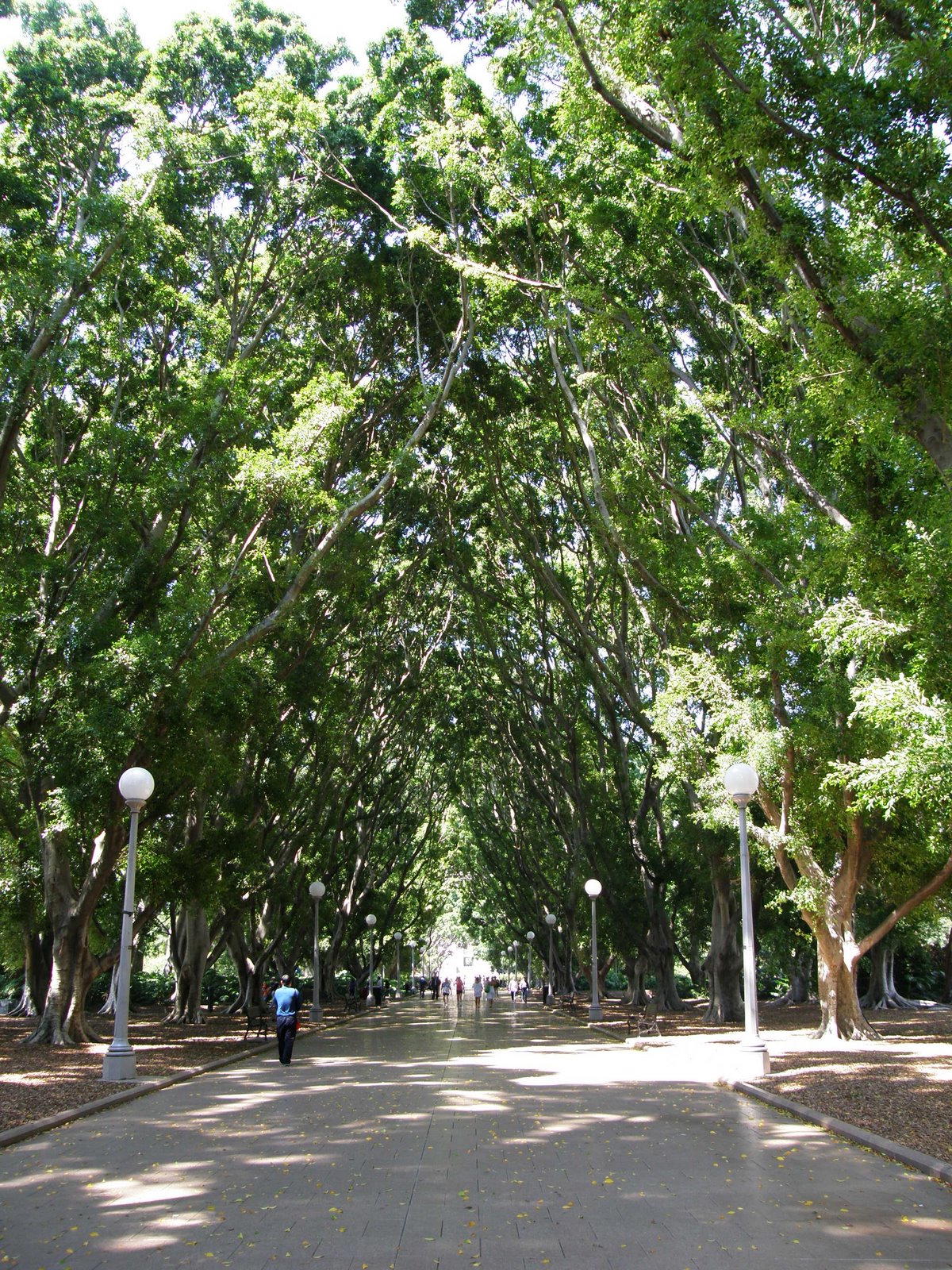
After I arrived on the midnight terror (Australian for a redeye flight) from Perth I found accomodations and began the whirlwind tour. First stop was Hyde Park. Sydney is full of typical urban parks with fountains, sculptures, green lawns, and walks lined with huge trees, but the best thing to me about Hyde Park is the Australian and New Zealand Army Corps (ANZAC) memorial. It's a small rotunda at one end of the park. Inside you look down on a sculpture of a soldier laying on a sword stretched across the ANZAC insignia. Engraved into the wall all around are the names of the major battles and campaigns ANZAC has been involved in over the past 100 years or so. They also have an eternal flame for fallen soldiers and a small but well-presented exhibit of ANZAC history and artifacts. I didn't realize it before visiting the memorial but ANZAC has partnered with the US military in many of our major actions over the years, so ANZAC's history has closely resembled the history of our own military. Beside learning of our significant history of cooperation, I also learned that our troops probably weren't sharing rations in their foxholes. Most of us Yanks find Vegemite nasty but judging by the numbers of Vegemite tins on display at the memorial it seems that Vegemite is a critical part of any Australian soldier's rations while overseas. Apparently Aussies just can't get by without the stuff.
After Hyde Park I went to the Royal Botanical Gardens. It's a massive green space between the CBD and Circular Quay, which is the wharf in downtown Sydney near the opera house. It has all kinds of displays of vegetation from all over the world and is a great place to spend a day. It also has views of the harbour, opera house, and harbour bridge from the lower gardens. I was walking through a section of tropical vegetation from Indonesia or somehere like that when what I can only describe as a pterodactyl-like shape blotted out the sun overhead. I looked up to see the largest bat I'd ever seen flying through the trees. I looked around and realized that I was surrounded by hundreds of them. I later learned that they are fruit bats and they roost in the botanical gardens in such large numbers that they are killing the trees in the gardens. They sort of look like giant hairy brown teardrops hanging from the trees. I admit it was unsettling seeing a bat with a three foot wingspan flying around in the daytime and then realizing that about two hundred of his friends were staring at me from not very far away.


I finished up the day by doing some of the more conventional touristy things in Sydney, like walking the Sydney Harbour Bridge and checking out the opera house. Both are nice; the views from the bridge are pretty spectacular and the opera house is impressive, although it's a bit smaller than what I had imagined from the postcards. I also walked through some of the oldest sections of town by the base of the bridge. It's full of little old shops and pubs that have an out of the way feel to them.


The next morning I took a tour of Government House, which is the governor general's official residence in Sydney. The governor general is an appointed representative of the queen in New South Wales. The house was very stately, and the tour guide related some amusing anecdotes about the early government in New South Wales. For example, one of Sydney's first police chiefs or judges ( I can't remember which) was himself a criminal who had been exiled to Australia for a long string of offenses in England. After being shipped here as a criminal he had a long and illustrious career enforcing the laws he had broken at home. Another amusing anecdote concerns the artwork in Government House. At the time the house was built photography had not been invented, so the original decorations were all paintings. Of course Sydney was still a convict colony at that time, so it wasn't a very appealing place for accomplished artists to go to paint their masterpeices. The queen couldn't convince a qualified artist to go to Syndey to decorate Government House properly, so she commissioned an artist in England to paint scenes of the harbor and the surrounding countryside from written descriptions, and she shipped the pieces down to be displayed. The predictable result is that the paintings hanging in Government House today purport to represent Sydney and the harbor, but they look nothing like the real Syndey landscape, then or now. Of course the paintings can't be replaced now because they're priceless antiques, so the Governor General will probably just go on presenting a room full of pretty pictures of places that don't exist to foreign dignitaries.

After grabbing some fish and chips down at the quay and talking to some people from the US that I met on the tour, I jumped on the harbour ferry. The view from the ferry was of exclusive waterfront neighborhoods wedged side by side with ruins of prisons that held the worst of the worst transported convicts. We passed Sydney's version of Alcatraz, Fort Denison. These days they rent it out for weddings. As we passed the fort I had been having a very pleasant conversation with a couple about my age about life in Australia. The sight of the fort prompted me to remark to them that Australia, which is largely a safe, pleasant place, is what happens when you give the inmates the keys to the jail. I don't think they appreciated the irony and the conversation got a bit icy after that.

The ferry docked at Manly Beach, which is one of the better known surf suburbs of Sydney. It borders a headland that forms the north shore of the habour known as North Head. There is a waterfront walk along the entire beach that leads up through the woods on North Head. Apart from the water dragons that dangle from the rocks and trees along the way, the waterfront walk is reminiscent of a mediteranean stroll through a Greek village. If the the scenery wasn't enough to make me think I was on the Riviera, all the overweight Euorpean men in little bikini swimming suits completed the effect.


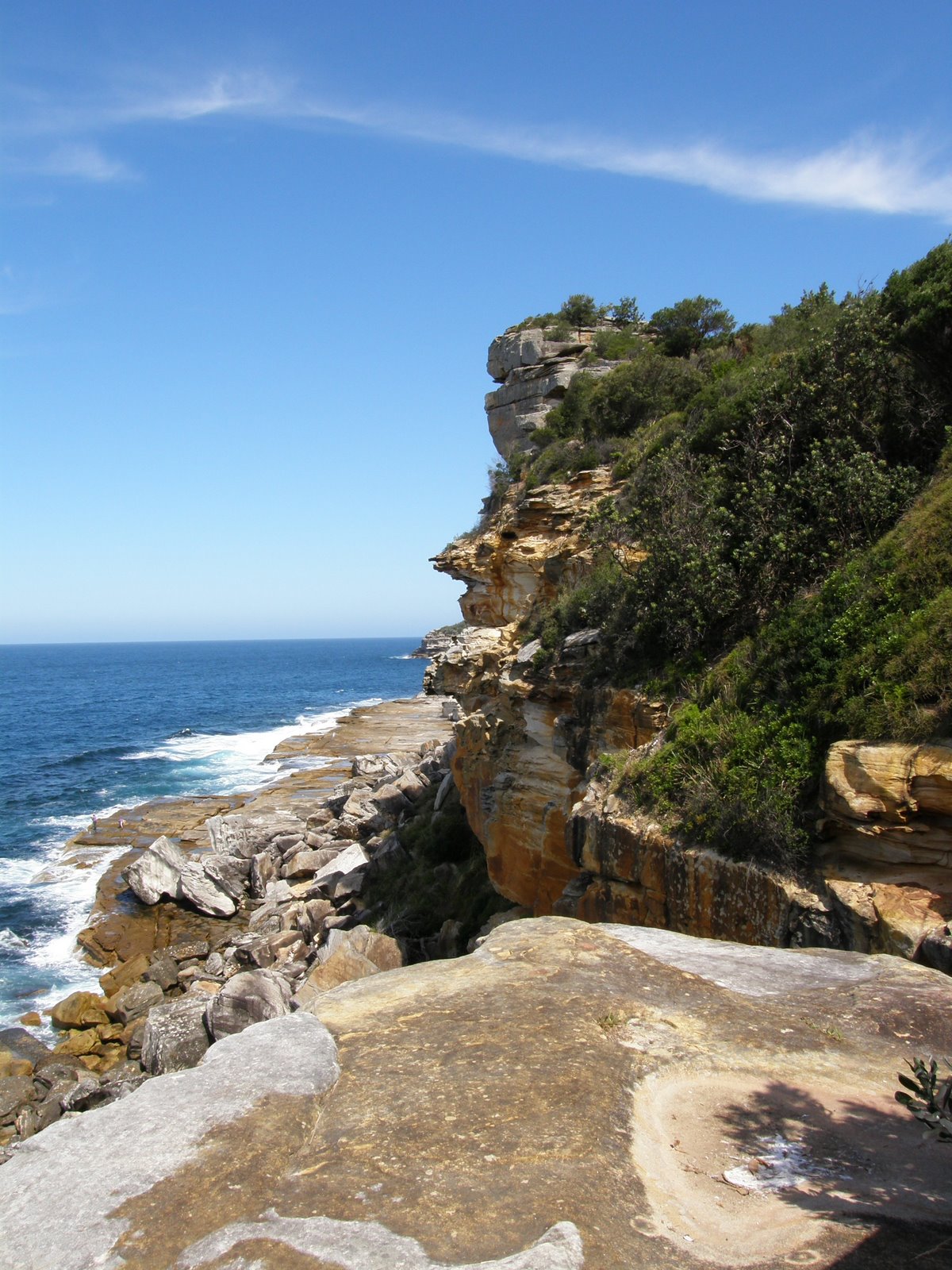
The views from North Head are spectacular. Cliffs hundreds of feet tall front on the Pacific Ocean. The bright blue of the ocean and sky create a striking contrast with the tan and red of the cliffs. Looking out over the ocean you almost expect to see humpback whales breaching offshore, and in late summer you've got a good chance of doing just that as they make their way up the coast from their summer feeding grounds in the Southern Ocean. If you turn around and walk through the woods away from the ocean you see the skyline of Sydney. Further up North Head there are ruins of anti-aircraft gun placements that were installed after the Japanese bombed Darwin at the outset of hostilities in the Pacific during World War II. Although Sydney was eventually torpedoes by Japanese midget subs, the aerial attack on Syndey never came, but the munitions magazines, gun foundations, and concrete bunkers indicate how seriously the Australians took the threat.

After walking around Sydney, Manly Beach, and climbing up to the top of North Head, I was knackered, so I decided to call it a day. There was nowhere else to go except off the cliff edge anyway, so it was back to Manly, across the harbour, and out for a nice Indian dinner in Sydney. I only had two days of work before I was to see what all the fuss was about at a big rock that I heard so much about in the middle of the desert.


1. Eucalyptus trees in Hyde Park
2. Sculpture in the ANZAC memorial
3. Fruit bats in the Royal Botanical Gardens
4. A curious fruit bat
5. Sydney Opera House
6. Sydney Harbor from the bridge
7. Government House
8. Water dragon
9. Cliffs at North Head
10. Antiaircraft gun placement


Wednesday, November 14, 2007

Yanchep

One of the great things about living in Perth is all of the public land that’s around. Virtually the entire coast is public, and they have all kinds of bushland reserves and national parks scattered everywhere. Here national parks are very different to the ones in the US. They are smaller than the ones in the US, there are a lot more of them, and they're more like our state parks in terms of size and the types of resources they offer.

One of the national parks I’ve visited is Yanchep, about 45 minutes north of Perth. We checked out a cave which had some nice flowstone and other formations, but had really been beaten up by intensive tourist traffic over the years. We also saw some koalas that weren’t quite wild, but nearly so. I was amazed to learn that a big tourist attraction in Australia is “koala cuddling” which is pretty much just what it sounds like: people paying to pick up, hug, and generally antagonize koalas. They are nuts-I have seen the claws on those animals and there is no way I’ll be cuddling any koalas.

The best part of Yanchep by far is the presentation on Aboriginal life. Our teacher was a member of the Noongar people, which is the primary aboriginal group in the Perth area. First we learned how the dot paintings that aborigines make are actually like our books, in that they tell stories. Then we watched an aborigine make a special glue out of tree sap, ashes from a fire, and kangaroo poo (no kidding). It looks like tar but it dries hard in about twenty minutes. They use this stuff to bind just about any kind of natural material together. The best part about it is it's strong enough to hold tools like axes together, but if the tool gets worn or dull you can heat up the glue and it gets pliable again, so you can reuse it over and over. After going through some of the traditional tools he showed us how to make fire, but I need to go to remedial fire making class because all I could get was a little smoke. I don't feel bad though because at least I tried. The only other guy who tried didn't even get that far.

After the fire making failure it was time for music and dancing. He showed us how to play the digeridu, which involves breathing out into the cheeks, then forcing the air out of the cheeks while breathing in through the nose. Using this technique a digeridu player can play continuously without pausing for a breath. He explained that authentic digeridus are not manufactured by people, but are created from trees that are naturally hollowed out by termites. After the digeridu lesson he taught us traditional party song and the accompanying dance, and finished the session by performing the traditional fishing dance, which is basically a ritualized version of the movements one would use to stalk and spear fish in shallow water. It was all great fun and I learned very much.


Photos:

1. Flowstone, stalactites, and stalagmites in Yanchep cave.
2. Me failing to make fire.
3. Playing the digeridu.
4. The fishing dance.